Ertragsmanagement

OPTIMIZE REVENUE, INVENTORY, AND MARGIN ACROSS THE PRODUCT LIFE CYCLE. 

Quicklizard Revenue Management combines SKU-level demand forecasting, price architecture, and inventory-aware optimization to set the right price for each item at each stage of its life cycle, maximizing revenue and profit while reducing markdowns and excess stock.
Revenue Management hero image

When Inventory and Pricing Fall Out of Sync

Retail revenue management depends on aligned pricing, promotions, and inventory. Revenue management software unifies these signals so pricing decisions stay proactive across the product life cycle. The result:

Lifecycle Mispricing

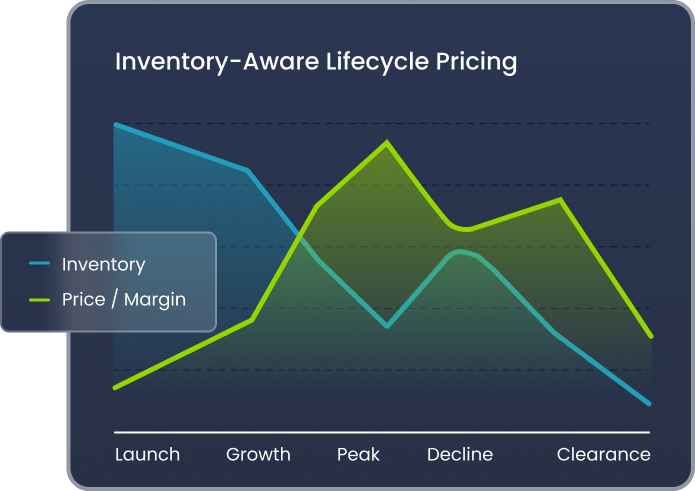
Hero SKUs and long tail items require different strategies which must be adapted according to each SKU’s lifecycle stage from listing to delisting - generic and static rules cause margin loss or excess stock.

Inventory-Driven Margin Loss

Overstocks trigger rushed markdowns, while low inventory leaves margin on the table.

Siloed Decision Making

Merchandising, pricing, and operations work from different data, creating conflicting actions.

No Total Contribution View

Teams optimize price or sell through in isolation instead of total revenue, margin, and stock turn.

Revenue Management solves this by aligning pricing, promotions, and inventory to maximize lifetime revenue and margin, not short term sales.

Die Quicklizard-Lösung

Forecast. Optimize. Execute.

Our Revenue Management solution optimizes pricing across the product life cycle for large assortments and complex inventory realities. We combine SKU-level demand forecasting, article roles, and price architecture to recommend the right price at each stage, balancing revenue, margin, and stock turn.

1 Article Role and Life-cycle Strategy

Role driven lifecycle pricing. Classify SKUs as key value items, sales drivers, and profit generators, then assign lifecycle strategies for when to hold price, promote, and plan markdowns. Role driven pricing prevents blanket rules and aligns decisions to business goals.

2 Demand and Inventory-Aware Forecasting

By leveraging SKU-level demand forecasting, we account for seasonality, promotions, channel mix, and competitor signals. Our inventory-aware models predict sell-through velocity and flag stock-out risks or excess inventory before they impact your availability, recommending price paths that prevent waste and avoid forced clearance.

3 Price Architecture and Contribution Optimization

We establish a unified price architecture for your entire catalog by defining price ladders, pack size architectures, and product families. This allows you to optimize total contribution across revenue, margin, and stock turn by setting specific targets for different SKU cohorts rather than focusing on sales alone.

4 Strategic Planning and Automated Execution

We simulate the timing and depth of promotions and markdowns to maximize net revenue based on real time inventory signals. Strategy is translated into action via Price Automation with a continuous feedback loop that uses post action analysis to refine future forecasts and pricing rules.

Auswirkungen auf das Geschäft

Die Auswirkungen auf einen Blick

Higher total contribution

Align pricing and inventory to increase revenue and margin across the product life cycle.

Reduce clearance driven losses through proactive lifecycle pricing.

Accelerate sell through with optimized price paths while protecting margin.

Plan promotions with inventory signals to drive higher net uplift.

Reduce manual interventions and cross team friction with faster, evidence based decisions.

Entdecken Sie die Plattform

Turn Inventory into a Strategic Advantage

Fragen, die Sie sich bereits stellen

What is revenue management?

Revenue Management optimizes prices and inventory policies across the product lifecycle to maximize total contribution (revenue + margin + stock-turn).

Dynamic Pricing reacts to near-term signals (competitors, demand); Revenue Management plans across horizons and inventory constraints to maximize total contribution over time.

Yes, POS and in-store transaction data are critical for accurate sell-through, promo attribution and omnichannel alignment.

Yes, cross-elasticity and SKU relationships are part of the optimization to avoid unintended cannibalization and to maximize portfolio contribution.

Absolutely - promo simulation and markdown planning are core features, integrated with Promo Effectiveness and Price Automation.