Die Datenreise

FROM RAW FEEDS TO TRUSTED PRICING DECISIONS

Quicklizard collects, cleans, and enriches data into one trusted harmonized data foundation, then turns it into features, models, and explainable recommendations that power forecasting, elasticity, CSI, and automated price execution. Forecasting, elasticity, CSI, promo lift, and optimizers run on the same trusted inputs.
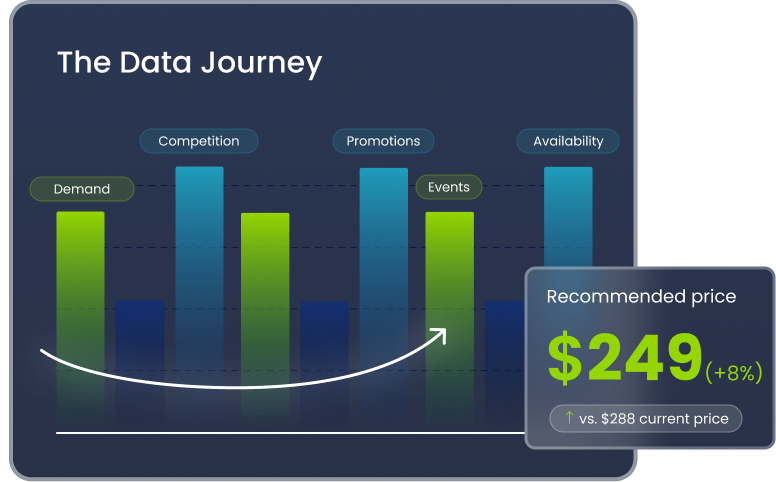
The Data Journey hero image

When Data is Fragmented, Pricing Becomes Unreliable

Pricing teams rely on many data sources, but the data journey is often fragmented across different systems, owners, and cadences. When inputs are inconsistent or poorly governed, even the strongest models produce unstable outputs.

Mismatched Inputs and Identity

Versions of data often vary between modules like forecasting and execution, while SKUs frequently appear differently across various systems, channels, and competitors.

Missing Context and Attribution

Critical factors such as promotions, events, and availability are not captured consistently, and noise in inputs leads to biased models and unreliable attribution.

Fragile and Ungoverned Automation

 Inconsistent data inputs result in unstable outputs from models, making automation fragile and prone to outsized downstream impacts without safe controls.

System and Cadence Fragmentation

Data journeys are often split across multiple legacy systems and mismatched update cycles, making it difficult for pricing teams to maintain a single version of the truth.

Dynamische Preisgestaltung muss vorhersehbar, überprüfbar und auf die Unternehmensstrategie abgestimmt, kein „Black-Box“-Experiment.

Die Quicklizard-Lösung

From Data to Controlled Execution

We run every step from collection to execution on the same trusted inputs to turn raw feeds into features, models, and explainable recommendations.

1 Connect and Align

Required data feeds are connected and formats are standardized to resolve product identity. This ensures every system and channel maps to the same SKU across the entire catalog.

2 Enrich and Govern

Segmentation and demand drivers are added before storing results in a trusted data foundation with traceability and access controls. Inputs are enriched with events and market context so models attribute demand drivers correctly.

3 Govern and Decide

Signals are transformed into features to run validated models and generate ranked actions with thresholds that support automation or review. Scenario testing is supported to compare options before execution.

4 Execute and Learn

Decisions are executed with controls and a full audit trail while quality and drift are monitored to retrain models. This closed loop approach improves stability as market conditions change.

Auswirkungen auf das Geschäft

Die Auswirkungen auf einen Blick

Consistency across modules

Forecasting, elasticity, CSI, and execution all run on the same trusted inputs.

Stronger context improves the measurement of drivers like promotions, events, and availability.

Integrated controls and monitoring reduce fragility when data feeds lag or shift.

Standardized inputs eliminate the need for manual reconciliation and rework.

Traceable actions and explainable logic support reporting, finance, and internal controls.

Entdecken Sie die Plattform

See How Your Data Can Move from Raw Feeds to Controlled Price Execution

Fragen, die Sie sich bereits stellen

How do you handle data quality issues?

Automated validations, reconciliation reports and daily checks; discrepancies quarantine affected rows and trigger alerts while fallbacks keep automation safe.

Yes, Quicklizard supports hashed IDs and privacy-preserving joins to meet GDPR and data-minimization requirements.

Fast pilots run in weeks; full rollouts typically plan for ~10–14 weeks depending on integrations.

The platform standardizes formats to resolve product identity across your entire stack. This ensures every system and channel maps to the same SKU, eliminating mismatched versions of the truth.

Every decision is executed with a full audit trail and traceable actions that link changes directly back to inputs and model logic. This provides the transparency needed for internal controls and financial reporting.