Optimierung der Preisgestaltung

Optimize every price.
Across every channel.
In real time.

Quicklizard is a modular, enterprise-grade dynamic pricing platform that combines competitive pricing intelligence, hybrid AI optimizers, and governed price automation to boost revenue, margins, and sell-through for retailers and brands.

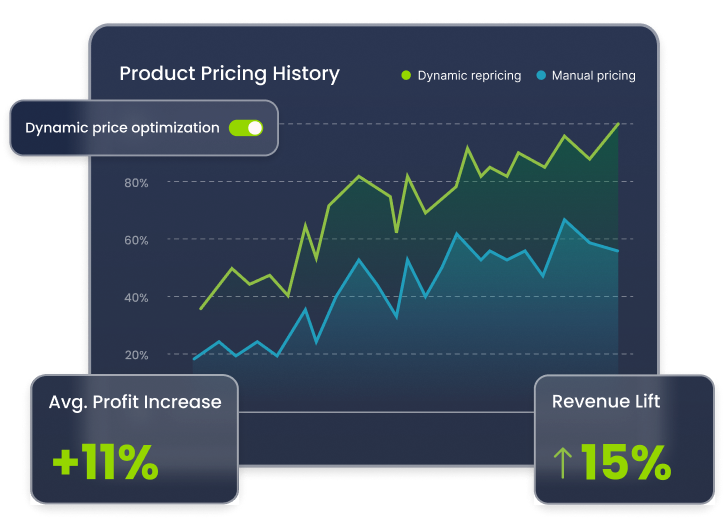
Pricing Optimization hero image

Pricing Complexity is Costing you Profit

Multiple competitors, rapidly changing demand, and massive catalogs render manual pricing and simple rules unreliable. The result:

Verpasste Chancen

Slow response to demand spikes and competitor moves that leave revenue unrealized and cede competitive advantage.

Margin Loss

Poorly timed markdowns and reactive undercutting that steadily erode profitability in a vicious cycle.

Operational Strain

Spreadsheet-driven workflows and manual exception handling that consume capacity and increase decision latency.

Channel Conflict

Inconsistent pricing across e-commerce, marketplaces, and stores that undermines execution and creates channel friction.

We solve these challenges with a single governed platform that centralizes your data and automates smart, profitable pricing decisions at scale.

Die Quicklizard-Lösung

A Unified, Modular Platform

Built on enterprise-grade data and a hybrid AI engine, Quicklizard consolidates all pricing capabilities so teams can deploy the modules they need and scale safely.

1 Zentralisierte Daten und Informationen

We unify transaction-level internal data with real-time market and competitor signals. The result is a single, trusted data foundation for accurate, auditable pricing decisions.

2 AI-Driven Strategy and Optimization

We apply modular machine learning optimizers to generate price recommendations and strategy choices. The models update in real time based on inventory, cost, competitor activity, and shifting elasticities.

3 Automated Execution and Control

Hybrid automation enforces configurable commercial policies, defined and owned by your pricing team, including margin floors, MSRP, MAP and RRP, alongside AI generated price recommendations. It supports fully automated execution within guardrails, hybrid approval workflows, and manual overrides. Staged rollouts and continuous monitoring ensure controlled, auditable scaling.

4 Automated Execution and Control

Hybrid automation enforces configurable commercial policies, defined and owned by your pricing team, including margin floors, MSRP, MAP and RRP, alongside AI generated price recommendations. It supports fully automated execution within guardrails, hybrid approval workflows, and manual overrides. Staged rollouts and continuous monitoring ensure controlled, auditable scaling.

Auswirkungen auf das Geschäft

Die Auswirkungen auf einen Blick

Maximized profitability

Proactively meet margin goals with profit-first pricing and optimizer-driven decisions.

Achieve growth targets without sacrificing profits.

Auditable, rule-based pricing with clear guardrails and transparent decision logs.

Reduce pricing cycles from days to minutes to capture short-lived demand and competitor windows.

Handle millions of SKUs across channels and stores so pricing scales with your business.

Entdecken Sie die Plattform

Fordern Sie eine individuelle Demo der Plattform an

Fragen, die Sie sich bereits stellen

What is Price Automation?

A continuous engine that executes your pricing strategy across SKUs, categories and channels by combining configurable business rules with AI-driven recommendations.

No. It automates operational work, not strategy. Teams set goals, rules and approvals; the platform explains every recommendation and preserves manual overrides.

Fast pilots run in 4-8 weeks. Typical pilot inputs: 90-180 days of transaction/POS history, catalog & inventory, promotions and a sample competitor feed. We handle mapping and normalization.

Updates run only when configurable thresholds, confidence bands and business rules are met. Every execution includes audit metadata, model-version tags and hybrid approval options.

The platform pushes prices to web, marketplaces and in-store systems (including ESLs) and enforces channel logic, margin floors and regulatory rules (MAP/MSRP/RRP) as configurable constraints.