Pricing Automation

AUTOMATE PRICING DECISIONS AT SCALE, ALIGNED WITH YOUR PRICING STRATEGY

Quicklizard Price Automation replaces manual price maintenance with a scalable automation engine that runs continuously across SKUs, categories, and channels. AI optimizers run inside your commercial rules and guardrails, so pricing teams define strategy while the platform executes continuously at scale. Customers achieve up to 15% revenue uplift and ~11% Avg profit Increase.
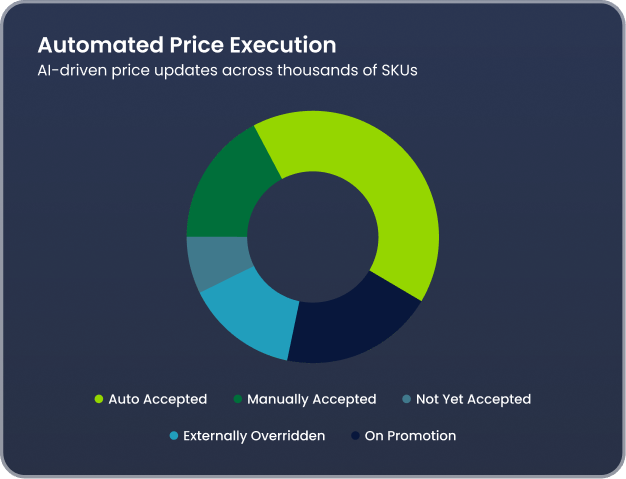
Automated Price Execution dashboard

Why Manual Pricing No Longer Works

Manual spreadsheets and static rules cannot keep pace with the multi-dimensional complexity of modern retail. Relying on slow, manual cycles creates operational bottlenecks that leave revenue unrealized and margins undefended.

Scale and Relationship Complexity

Manually maintaining millions of SKUs and linked product structures like bundles or variants is slow and error-prone.

Volatile Market Signals

Delayed responses to rapid competitor moves and shifting inventory targets lead to "stale" pricing and missed opportunities.

Omnichannel Friction

Disconnected pricing between web, marketplaces, and physical stores erodes customer trust and margin consistency.

Compliance Risks

Navigating complex regional regulations and manufacturer price floors (MAP/MSRP) at scale is nearly impossible without automation.

Price Automation addresses these pressures by delivering an intelligent, scalable, and economically disciplined engine that executes your strategy in real-time.

The Quicklizard Solution

The Pricing Automation Platform, Built for Control

We deliver price automation that pricing teams can trust. This is not about handing decisions to a black box. It is about combining transparent rules, AI pricing optimization, and reliable execution so your strategy is enforced while automation runs continuously.

1 Hybrid Decisioning (Rules Plus AI Pricing Optimization)

We combine a transparent rules engine (min/max prices, margin floors, channel & legal constraints) with AI optimizers. The AI proposes prices; business rules ensure every recommendation aligns with your strategy and brand.

2 Safety and Transparency

Every recommendation is explainable (inputs, logic, expected impact). Automation is guarded by configurable thresholds, confidence bands and approval workflows, and every execution records model versions and audit metadata.

3 Omnichannel Price Execution

Price Automation executes across e-commerce, marketplaces, and stores (including ESLs and POS). Channel-aware logic (sync rules, channel corridors) prevents conflicts and preserves intended price differences.

4 Fast Integration and Speed to Value

Pre-built connectors (ERP/POS, Shopify, Magento, BigCommerce), APIs, and secure batch options let teams pilot quickly and scale. Fast pilots (4–8 weeks) validate uplift; enterprise rollouts follow a staged program (≈ 10–14 weeks).

Business Impact

Impact at a Glance

Faster pricing cycles

Accelerate time to price and time to market response.

Reduce manual price maintenance and eliminate repeat errors.

Improve pricing accuracy and execution consistency across channels.

Drive incremental margin and reduce unprofitable markdown decisions.

Enable pricing teams to focus on strategy and category performance.

Explore the Platform

Discover how Price Automation can transform your pricing operations while keeping you in full control

Questions You’re Already Asking

What is Price Automation?

A continuous engine that executes your pricing strategy across SKUs, categories and channels by combining configurable business rules with AI-driven recommendations.

No. It automates operational work, not strategy. Pricing teams set goals, rules and approvals; the platform explains every recommendation and preserves manual overrides.

Fast pilots run in 4–8 weeks. Typical pilot inputs: 90–180 days of transaction/POS history, catalog & inventory, promotions and a sample competitor feed. We handle mapping and normalization.

Price updates only run when configurable thresholds, confidence bands and business rules are met. Every execution includes audit metadata, model-version tags and hybrid approval/rollback options.

The platform enforces channel logic, margin floors and regional policies (e.g., MAP/MSRP/RRP as configured) and pushes prices to web, marketplaces and in-store systems (including ESLs).