Quicklizard builds SKU-level and cross-SKU elasticity models and demand forecasts that quantify how price changes affect demand by SKU, category, channel, and region. These models help generate price recommendations that balance demand with commercial objectives and prioritize incremental profit over volume alone.
Quicklizard’s AI-powered dynamic pricing platform uses SKU-level elasticity, demand forecasts, competitive pricing, and business rules to optimize prices in real time across every SKU and channel, maximizing margin and revenue while maintaining full transparency and business control.
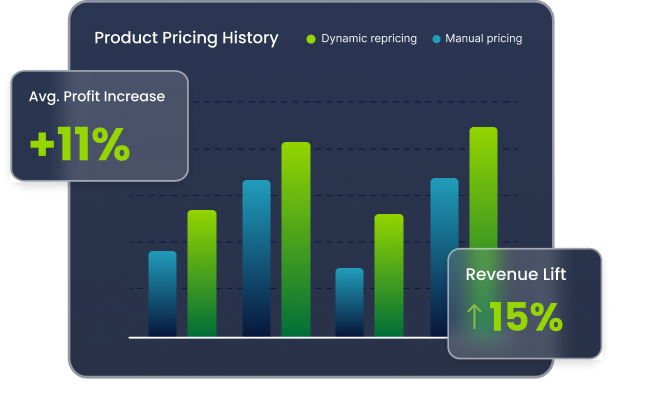
The Problem: Slow Pricing Leaves Money on the Table
Retail pricing is complex and fast-moving. Manual updates, static rules, and slow decision cycles create strategic and operational gaps:
Missed Opportunities
Delayed responses to demand spikes, pricing gaps, and competitor moves leave revenue unrealized and can weaken competitive position.
Margin Drift
One-size-fits-all rules, unnecessary price matching, and delayed or exagerated markdowns can steadily undermine profitability.
Operational Overload
Pricing teams spend too much time in spreadsheets and exception handling instead of focusing on strategy.
Channel Misalignment
Pricing inconsistencies across e-commerce, marketplaces, and stores can erode margins and undermine customer trust.
Dynamic pricing should be predictable, auditable, and aligned to business strategy, not a black-box.
The Quicklizard Solution
How Quicklizard’s Dynamic Pricing Software Works
Built for complex assortments and omnichannel execution, Quicklizard combines AI-driven pricing with configurable business rules to deliver speed, explainability, and commercial control. The platform brings together price elasticity, demand forecasting, competitive pricing, simulation, and pricing automation to help retailers make and execute pricing decisions at scale.
Dynamic Pricing Use Cases for Retailers
Quicklizard helps retailers apply dynamic pricing across different commercial scenarios, from AI-driven price optimization and demand-based pricing to inventory-aware and omnichannel execution.
01
AI-Driven Price Optimization
Use AI-powered price optimization models to analyze demand, elasticity, inventory, competitor prices, and business constraints and recommend prices that support revenue and profit objectives.
03
Inventory-Aware Pricing
Incorporate inventory levels and sell-through into pricing decisions to respond earlier to overstock, changing demand, and product lifecycle conditions.
Dynamic
Pricing
02
Demand-Based Pricing
Adjust prices as demand changes using SKU-level elasticity and demand forecasts to identify opportunities to improve revenue and margin.
04
Omnichannel Pricing
Coordinate dynamic pricing across e-commerce, marketplaces, regions, and physical stores while maintaining channel-specific strategies and business rules.
Impact at a Glance
Quicklizard helps retailers turn dynamic pricing into measurable commercial and operational improvements:
From Pilot to Profit: Our Customer Success Stories
See how retailers use Quicklizard’s dynamic pricing and price optimization capabilities to improve profitability and automate pricing at scale.



Why Choose Quicklizard’s Dynamic Pricing Platform?
A powerful, flexible, and transparent approach to dynamic pricing, built for the realities of retail.
01
Explainable, No Black-Box AI
Quicklizard provides transparency into how price recommendations are generated, allowing pricing teams to understand the factors behind a decision while maintaining control through business rules, guardrails, approvals, and overrides.
02
AI + Business Rules in One Decision Engine
Combine AI-driven price optimization with retailer-defined pricing rules and commercial constraints, so recommendations account for both model-driven insights and the realities of your pricing strategy.
03
Flexible Levels of Automation
Start with price recommendations, introduce approval workflows, or automate pricing decisions within predefined guardrails. Teams can determine the level of automation that fits different categories, markets, and pricing scenarios.
04
Built to Connect With Your Pricing Ecosystem
Integrate dynamic pricing with existing commerce, ERP, POS, marketplace, and data systems so pricing decisions can use relevant business data and be executed across existing retail workflows.