Seasonality

UNDERSTAND RECURRING DEMAND PATTERNS. PRICE SMARTER. PLAN BETTER.

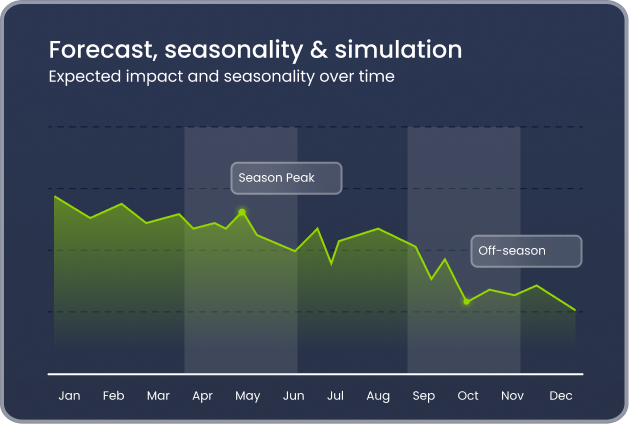
Quicklizard models seasonality at SKU, category, and channel level, including special dates, holidays, weekday and time patterns, and weather. This ensures forecasts, elasticity, and price optimization remain accurate across recurring demand cycles and allows to automate seasonal pricing.
Seasonality hero image

Seasonality Is Not One Size Fits All

Demand follows recurring cycles, but traditional seasonality modeling often relies on basic curves or generic holiday flags that fail to capture real world complexity.

Overly Simplified Factors

Basic seasonal factors often miss SKU level, channel specific, and regional patterns, leading to inaccurate demand signals.

Wrongful Attribution

Without proper controls, demand shifts are frequently distributed to price or promotions when they are actually driven by seasonal cycles or competitor moves.

Granularity and Blind-Spots

Traditional models often ignore weekday, time of day, and store versus online effects, creating significant distortions in baseline forecasts.

Weather Sensitivity Gaps

Critical weather driven swings are often missed, particularly in highly seasonal categories where local conditions dictate immediate demand.

Seasonality needs to be treated as a first class signal that is measured and applied consistently across forecasting, pricing, and planning.

The Quicklizard Solution

Comprehensive Demand Decomposition

We build seasonality into every step of the pricing stack to ensure downstream optimizers act on clean, conditional demand signals rather than seasonal noise.

1 Cyclical Pattern Recognition

We automatically detect recurring demand patterns at the correct cadence for each SKU and channel. By using statistical decomposition and machine learning change point detection, the system identifies intraday, weekday, weekly, and yearly cycles to establish a reliable foundation for all demand signals.

2 Special Dates and External Signal Detection

Our models encode holidays, regional events, and weather indices as structured predictor variables. By incorporating built in calendars and local schedules, we capture the impact of regional events consistently, ensuring that price and inventory plans account for external demand drivers.

3 Conditional Price and Promotion Impact Extraction

We measure seasonality together with price elasticity and promotional lift to isolate true behavioral changes. This conditional approach captures how price sensitivity shifts during seasonal peaks, preventing the over or under estimation of promotional impact during high demand periods.

4 Intelligent Coverage and Extrapolation

Models are built separately by region, channel, and product role to account for local variances. We use hierarchical time series methods and geo clustering to share signals when SKU data is thin, allowing the system to learn store specific spikes and city level weather patterns across the entire assortment.

Business Impact

Impact at a Glance

Fewer stock-outs at peaks

Seasonality aware forecasting prevents missed sales by identifying predictable demand spikes before they occur.

Precisely forecasting the end of season allows for better timing and depth of discounts.

Planning campaigns within a specific seasonal context ensures cleaner lift and more efficient marketing spend.

Aligning price increases or temporary offers with natural demand windows captures additional value during high interest periods.

Using region aware seasonality reduces hedging and enables teams to execute highly differentiated local pricing strategies.

Explore the Platform

See How Price Automation Can Transform Your Pricing Operations, Without Giving Up Control

Questions You’re Already Asking

What counts as seasonality?

Seasonality includes repeating patterns such as time-of-day, day-of-week, weekly, monthly, holiday calendars, recurring events, and weather-driven cycles.

No, holidays are a part of seasonality but so are weekday patterns, intraday cycles, and local events. Quicklizard models all relevant scales.

We explicitly model promotions, price changes and competitor signals as covariates so seasonal estimates isolate recurring demand from promotional or competitive effects.

Yes, you can add custom event calendars and Quicklizard’s change-point detectors and retraining procedures adapt models quickly.

Holiday calendars, weather indices, mobility/footfall proxies, Google Trends and market indicators as needed for local seasonality.