Price Elasticity
LEVERAGE PREDICTABLE DEMAND RESPONSE TO OPTIMIZE FOR MARGIN AND GROWTH.
Quicklizard’s Price Elasticity models how demand responds to price changes at SKU level, including cross SKU effects, while accounting for promotions, competitors, seasonality, and price levels. This enables optimizers to simulate outcomes and choose price moves that maximize revenue or profit.
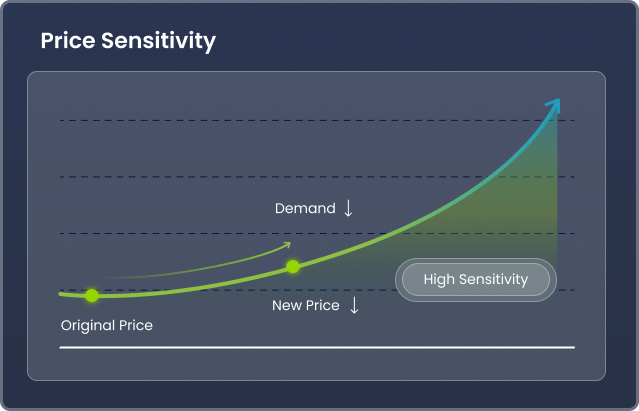
The Pricing Challenge Is Response, Not Price
Retailers often make price moves without a reliable view of demand response. When price elasticity modeling does not reflect real world conditions, price optimization decisions rely on static assumptions that increase execution risk.The result:
Elasticity is Not Static
SKU level price elasticity changes by context. It varies by price level, channel, and seasonality, so a single fixed elasticity misguides decisions.
Cross SKU Effects Matter
Cross elasticity means a price change on one item can shift demand across substitutes, complements, packs, and variants.
Promotions and Competitor Moves Bias Estimates
Without controlling for promotion lift and competitive signals, elasticity inputs become distorted.
Operational Risk
Inaccurate elasticity drives the wrong promo depth, the wrong markdown timing, and margin leakage.
Our Price Elasticity module turns elasticity from intuition into a measurable input for pricing strategy and execution.
The Quicklizard Solution
Measure. Model. Apply.
We treat price elasticity as a continuous input across the pricing stack. We measure elasticity and demand responses, then integrate those signals into simulation and optimizers that target incremental profit or revenue, not just volume.
Business Impact