
Introducing MCP, Model Context Protocol
Pricing systems have traditionally been built around structured interfaces. Dashboards, tables, and predefined workflows have been the primary way users interact with data, analyze performance, and define strategies.
While effective, this model limits how data can be accessed and used. It relies on predefined views and manual navigation, creating a gap between the intelligence available in the system and what users can actually act on.
At the same time, modern pricing platforms manage significantly more data and logic beneath the surface, including strategies, competitor insights, configurations, and historical performance. The limitation is no longer the data itself, but the interaction model.
Quicklizard is introducing MCP, Model Context Protocol, to address this shift.
A Structured Layer for AI Interaction
MCP defines how AI agents connect to data, services, and capabilities in a consistent and structured way. It introduces a layer that allows models to access real time information and execute tasks through standardized tools.
Capabilities are exposed through a catalog of MCP tools, which act as controlled entry points into backend services. This enables agents to retrieve data, apply logic, and take action within a real business context, moving beyond response generation into execution.
Decoupling the Engine from the Interface
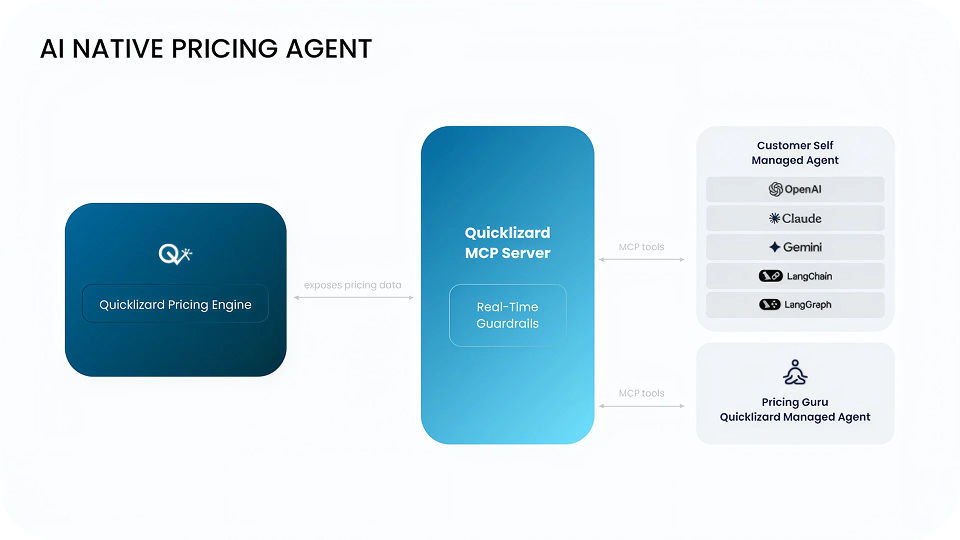
At the center of this approach is a separation between the Quicklizard engine and the interfaces through which its capabilities are used.
The Quicklizard engine remains the core system, where pricing logic, data, business rules, and backend services are managed. MCP sits as a shared layer around these capabilities, exposing them in a structured and standardized way.
This layer is not tied to a single agent or interface. It supports Quicklizard’s own managed agent, Pricing Guru, as well as customer selected agents built on models of Anthropic, Google, and OpenAI.
MCP is not the agent itself, and it is not a sequential step in a pipeline. It is the connective layer that makes Quicklizard capabilities available across different AI experiences.
From Prompt Based Systems to Agent Orchestration
MCP enables the transition from prompt based interactions to agent based systems.
A traditional LLM processes a prompt and returns a result. An agent can decompose a request, perform multiple actions, access different data sources, and iterate until it reaches a complete outcome.
This orchestration allows complex pricing tasks, such as generating strategies or analyzing performance across multiple dimensions, to be handled within a single interaction.
The Quicklizard Agentic AI Architecture
The MCP architecture is designed as a layered system that connects interaction, orchestration, and execution.
User interaction begins in a chat based sidebar within the customer browser. In the Quicklizard managed experience, requests are processed through a proxy and service gateway, which handle authentication, routing, and secure communication.
Within the Quicklizard managed experience, Pricing Guru acts as the managed agent, orchestrated using LangChain and deployed within Quicklizard infrastructure.The agent determines how to fulfill each request and coordinates the required actions across available tools and services.
Execution is supported by a LiteLLM gateway, which manages model routing, rate limiting, and per tenant budget control, and connects to best models in the market that fits the relevant task. This enables flexibility at the model layer while maintaining operational control and a cloud agnostic design.
Alongside this, MCP tools provide structured access to backend services. These tools support capabilities such as product search, price history, strategy analysis, promotions, performance evaluation, and competitor monitoring.
They connect directly to systems across stock, strategies, promotions, BI services, competition, archive, configuration, and pricing, ensuring outputs are grounded in real business data and can be translated into action.
To protect this ecosystem, the platform incorporates Real-Time Guardrails and Observability. While we utilize Langfuse for cost tracking and per-tenant auditing, and OpenTelemetry for service tracing, we have added an active security layer to defend against critical AI attack vectors, including:
- Prompt Injection: Preventing malicious attempts to hijack the agent’s logic.
- MCP Tool Poisoning: Ensuring the integrity of instructions and data passed to backend services.
- Tool Abuse: Monitoring for unauthorized or excessive tool calls to maintain system stability.
By embedding these protections directly into the orchestration layer, Quicklizard ensures that agentic pricing intelligence is not only powerful but enterprise-secure.
Expanding Access to Pricing Intelligence
This architecture changes how users interact with pricing systems.
Tasks that previously required navigating multiple dashboards, exporting data, or writing custom logic can now be completed through a single interaction. Filtering products, analyzing performance, refining configurations, and building pricing strategies move from manual workflows to natural language driven execution.
This reduces reliance on engineering for custom logic and makes advanced pricing capabilities accessible across the organization.
Extending Beyond a Single Interface
MCP is not limited to a single application layer.
By exposing MCP tools externally, Quicklizard enables customers to integrate pricing capabilities into their own environments, including BI systems, custom agents, and external tools.
Pricing intelligence can therefore be accessed through Quicklizard’s managed experience or through customer selected agents and workflows, depending on how each organization chooses to operate.
A New Foundation for Pricing Systems
MCP reflects a broader shift in how software systems are designed.
Interfaces are no longer the primary layer of interaction. Agents become the interface, and structured protocols define how they access and use system capabilities.
“MCP represents a shift from isolated AI features to fully orchestrated pricing intelligence systems. We are giving customers not just AI insights, but the ability to operationalize them securely and at scale,” said Yedidya Shwartz, CTO at Quicklizard.
By introducing MCP, Quicklizard is establishing a foundation for more flexible, scalable, and intelligent pricing systems, where data, models, and workflows are connected through a unified layer of interaction.