Competitor Sensitivity Index™ (CSI)

SELECTIVE RESPONSE FOR MARGIN DEFENSE

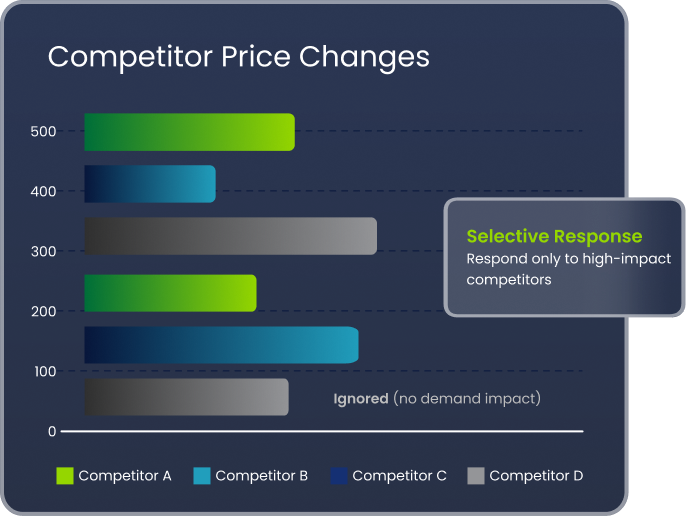
Quicklizard’s Competitor Sensitivity Index™ (CSI) identifies which competitor price moves change demand at SKU level, enabling teams to prioritize responses that protect margin and profit while filtering out market noise and reactive matching.
Competitor Sensitivity hero image

Not All Competitor Moves Are Equal

Competitive pricing teams are flooded with competitor price monitoring signals across channels and assortments. Without a reliable view of demand impact, teams react too often, match too broadly, and lose margin without improving outcomes. The result:

Noise Over Signal

Many competitor price changes do not move demand, yet they trigger reactions and unnecessary matching.

Margin Leakage

Reactive matching and blanket rules erode profitability and weaken price perception in a vicious pricing cycle triggering a race to the bottom.

Operational Drag

Analysts spend time tracking irrelevant moves instead of making high impact pricing decisions.

Unclear Competitive Set

Lack of clarity on which competitors matter creates inconsistent execution and strategic risk.

Pricing teams need a data driven answer to one question: which competitor price changes actually move demand at SKU level. CSI is built to deliver that answer.

The Quicklizard Solution

Demand-Driven Competitive Response

The Competitor Sensitivity Index™ (CSI) is a SKU level score that identifies which competitor price moves materially impact your customer demand, turning raw monitoring into actionable pricing signals. By measuring these causal effects, Quicklizard enables teams to identify their relevant competitor set and prioritize responses that protect margin and profit while filtering out irrelevant market noise.

1 Centralized Data and Intelligence

We collect and consolidate competitive pricing signals from diverse online and offline sources, including marketplaces and comparison engines. Robust product matching ensures every consolidated signal is mapped to the correct SKU to provide a reliable and up to date view of the entire market.

2 Causal Demand Sensitivity Measurement

Our models move beyond mere correlation by using statistical and machine learning techniques to measure how specific competitor price changes affect your demand. This measurement controls for critical external factors like seasonality, inventory levels, and promotions to isolate the true impact of competitor moves.

3 Prioritization and Dynamic Scoring

Impact is converted into a score that ranks competitors by their actual importance to your business, allowing teams to ignore moves that do not move demand. This dynamic prioritization identifies the relevant set of shoppers for every SKU and helps detect early signs of destructive pricing cycles before they erode margin.

4 Actionable Outputs and Continuous Learning

CSI scores feed directly into Price Automation and analyst workflows with clear, explainable signals for strategic decisioning. These models retrain continuously as competitor behavior and assortments change, ensuring your competitive responses remain aligned with current market conditions.

Business Impact

Impact at a Glance

Fewer unnecessary reactions

Reduce reactive price churn and avoid margin loss.

Respond only where demand impact is proven.

Expand automation coverage safely because CSI filters noise.

Spend less time investigating irrelevant competitor moves.

Tailor competitor response strategies by category, channel, or region.

Explore the Platform

Request a Personalized Demo of the Platform

Questions You’re Already Asking

What is CSI and how does it differ from simple competitor monitoring?

CSI quantifies the impact of a competitor’s price change on your SKU demand - not just that the price changed. It isolates causal effect and ranks competitors by actual influence.

CSI is derived from demand models that control for seasonality, promotions, inventory and other signals. Quicklizard uses robust statistical and ML techniques to estimate sensitivity and confidence intervals.

No, CSI augments monitoring by telling you which competitor moves matter and when to act, making monitoring actionable rather than noisy.

Yes, CSI scores and thresholds feed Price Automation so reactions can be automated when the predicted impact and confidence meet your business rules; hybrid approval modes are also supported.

CSI is refreshed on a schedule you choose (near real-time or daily), and models retrain continuously as more data and outcomes become available.